

During a typical snow event — and for several days afterwards — our Transportation crews closely monitor roads, sidewalks and primary pathways across town. We take a practical, organized approach to managing snow and ice to keep travel as safe as possible. Our top priorities are reducing the risk of accidents and injuries, keeping routes accessible for the public and emergency services, supporting active transportation, and helping minimize impacts to local businesses and the community.
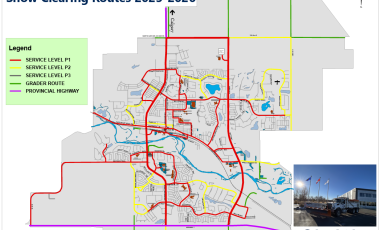
Snow Removal Based on Priority
In alignment with the Integrated and Accessible Transportation Policy, the Town implements snow and ice control activities based on a priority system (P1, P2, Grader, P3). This classification is based on traffic volume, safety considerations, accessibility to critical infrastructure, and operational efficiency.
Our goal is to ensure main transportation corridors are kept safe and accessible for all residents, including those using the fixed-route transportation system.
These are major transportation corridors that support the highest traffic volumes and provide essential community and emergency access.
Includes:
- Arterial and major collector roads (over 8,000 vehicles per day)
- Fixed transit routes
- Roads with significant safety risks (steep grades, sharp curves, single access subdivisions)
- Roads serving public or separate schools, destination commercial areas, downtown, and key municipal facilities
Service Level:
Start: Snow clearing and sanding operations will commence within 4 hours when approximately 4 cm or more has accumulated.
Finish: All routes in this category shall be cleared within 24 hours after the snow event ends
Note: Additional snow clearing (widening) may occur after all P1, P2, and Grader routes have received their initial response.Snow removal may be initiated when compacted snow on the road is sufficient to impede the flow of traffic, causes drainage concerns, or when windrows along the side of the road become excessive as determined by the Chief Administrative Officer. The Town will assume no liability whatsoever for damage to obstructions or landscaping of any kind placed or developed within a road right-of-way without a permit.
Collector roads with moderate traffic volumes and connections between neighbourhoods and Priority 1 routes.
Includes:
- Collector roads (2,000–8,000 vehicles per day)
- Roads serving vulnerable populations (e.g., care facilities)
- Roads with lower overall risk compared to P1 but still essential for mobility
Service Level:
- Start: Snow clearing and sanding operations will commence within 48 hours when approximately 4 cm or more has accumulated.
- Finish: All routes in this category shall be cleared within 48 hours after the snow event ends.
- Note: Additional snow clearing (widening) may occur after all P1 routes have received their widening pass.
Snow removal may be initiated when compacted snow on the road is sufficient to impede the flow of traffic, causes drainage concerns, or when windrows along the side of the road become excessive as determined by the Chief Administrative Officer. The Town will assume no liability whatsoever for damage to obstructions or landscaping of any kind placed or developed within a road right-of-way without a permit.
Snow and ice control operations are activated when the road is rendered impassable, poses significant safety concerns, drainage is impacted, extenuating circumstances exist, or when compact snow exceeds 25 cm.
Residential and local streets with low daily traffic volumes.
Includes:- Local roads (under 2,000 vehicles per day)
- Cul-de-sacs
- Residential-only access
Service Level: Snow and ice control operations are not automatic. They are activated only when:
- The road is rendered impassable
- Conditions pose significant safety concerns
- Drainage is impacted or extenuating circumstances exist
- Compact snow exceeds 25 cm
The Town of Okotoks pathway system consists of primary and secondary pathways. Primary pathways (red) are main pedestrian corridors that collect from a series of secondary pathways (black) to facilitate pedestrian movement from residential to commercial areas. Okotoks Town Council has determined that primary pathways will receive snow clearing as part of an overall pathway strategy to improve pedestrian movement year-round.
To facilitate active transportation, primary pathways are cleared once snowfall accumulation of approximately 2 cm or greater has occurred and is completed with twenty-four hours after the snow event has ceased. With the exception of December 25, 26 and January 1, primary pathway snow clearing is a 7 day service from November 1 through March 31.
Gravel, rural, or annexed roads requiring graders for snow removal.
Includes:- Gravel roads providing access to Town-maintained public and municipal facilities
- Main connection points in annexed rural roads
- Roads included in annexation agreements with timing commitments
Service Level:
- Start: Snow clearing will commence within 48–72 hours when approximately 4 cm or more has accumulated.
- Finish: All routes in this category shall be cleared within 72 hours after the snow event ends.
- Note: Additional snow clearing (widening) may occur after all P2 routes have received their initial response.
Snow removal may be initiated when compacted snow on the road is sufficient to impede the flow of traffic, causes drainage concerns, or when windrows along the side of the road become excessive as determined by the Chief Administrative Officer. The Town will assume no liability whatsoever for damage to obstructions or landscaping of any kind placed or developed within a road right-of-way without a permit.
Downtown Snow & Ice Clearing
Keeping the downtown area safe, accessible, and welcoming is a shared responsibility between the Town and adjacent property owners.
- Image
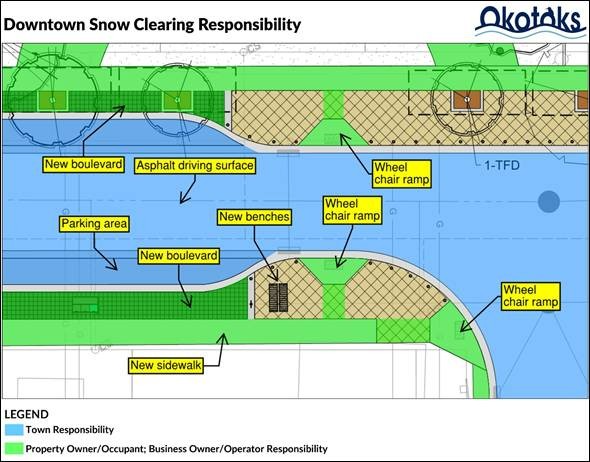
Town Responsibility (Blue on Map): Designated public spaces and priority roadway corridors.
Property Owner Responsibility (Green on Map): Clearing snow and ice from sidewalks, curb ramps, and boulevards adjoining your property.
- Snow cleared from private frontage or walkways must remain stored on private property—never pushed into roads, parking lanes, sidewalks, or Town spaces.
- Piles must not block pedestrian pathways, accessibility ramps, sight lines, or parking spaces.
- If on-site storage is insufficient, property owners are responsible for hauling snow away.
Frequently Asked Questions
Resident Responsibilities & Resources
Snow clearing on sidewalks is the responsibility of the adjacent property owner. Where sidewalks border parks, the Town provides the snow removal. Where sidewalks border businesses and residences, the private property owner is responsible. Sidewalks not cleaned may be subject to a fine.
The excerpt from Traffic Bylaw, Schedule A is as follows: “All persons within the Town of Okotoks shall remove and clean away, as soon as possible, and in any case within 24 hours, all snow, ice, dirt or debris and other obstructions from the sidewalk adjoining the premises owned or occupied by them.” Pushing snow onto public roads is also not permissible under the Traffic Bylaw.
Additionally, to ensure proper drainage and prevent ice buildup, the curbline must also be kept clear of snow and debris, allowing meltwater to flow freely into storm drains.
If snow or ice on the sidewalk cannot be removed, the property owner or responsible party must apply sand or a similar material to improve traction.
Once weather conditions allow, they must fully clear the sidewalk of snow, ice, and any remaining debris.
The property owner responsible for sidewalk maintenance may be held liable for any personal injury or property damage caused by failure to remove snow, ice, dirt, or other obstructions.For information contact Municipal Enforcement or call Transportation at the number below.
Snow Stockpiled Against Homes
Avoid any seepage issues with your home. It is good practice for homeowners during the winter and spring months to check all sides of their homes and remove any stockpiled snow against foundations - especially snow stockpiled near basement window wells. North and east sides of homes will be the worst (little winter sun exposure).
To assist with icy sidewalks during the winter months, the Town of Okotoks is offering free sand to its residents. Residents can pick up sand at the Eco Centre. Sand is also available at both fire halls located at 132 Milligan Drive, and 98 Woodhaven Drive.
The sand will be available for as long as it's required during the winter months; residents are asked to bring their own bucket.
While they appear fun in a child’s mind, snow piles on the edge of roadways are unsafe. Please keep children from playing on or in snow piles that have accumulated around town. Snow piles are unstable and there is a danger of them collapsing. There are also concerns of children sliding down onto the road and into traffic.
Winter fun is available! Visit our outdoor skating rinks and tobogganing hills page to learn about these facilities located on public lands throughout town. These amenities are free for public use and a great way to keep your family safe while staying active during winter. The tobogganing hills are inspected for hazards but are not groomed. Helmet use while sledding and skating is strongly recommended.
Town Operations & Road Maintenance
In the past, some residential streets may have been cleared inconsistently or based on older practices that didn't align with traffic needs. Under the standardized plan, roads are categorized strictly by data:
Priority 1: High volume roads. Highest traffic volumes and provide essential community and emergency access.
Priority 2: Moderate volume roads. Roads serving vulnerable populations (e.g., care facilities)
Priority 3 (Residential): Low-volume streets (<2,000 vehicles/day) and cul-de-sacs. If your street is a local residential road, it is no longer automatically scheduled for clearing unless snow accumulation exceeds 25 cm or deemed impassable.
When snow is plowed along identified routes, it is moved to the sides, clearing the driving and parking lanes. This process often results in piles of snow, known as windrows, which can accumulate in front of driveways on snow-cleared routes.
Property Owner Responsibility
Clearing windrows in front of your property is the responsibility of the property owner, as outlined in the Town's Traffic Bylaw. While the Town strives to minimize the impact of windrows, it is important to note that windrows left by snow-clearing equipment, including those in front of driveways, must be managed by the affected individual, company, or corporation.Flat-Blading on Priority 3 Routes
On Priority 3 routes, Town crews may use a process called "flat-blading" to create smoother driving surfaces. While this improves road conditions, it may also result in larger windrows along the sides of the road.There has been a general consensus of most citizens that given the nature of a normal winter and the number of “Chinooks” we experience, hauling snow away unless absolutely necessary is an inefficient use of tax dollars and resources. When hauling snow is deemed necessary, it is hauled to the Town's temporary snow storage facility.
The current location of the Town’s temporary snow storage facility is located at the Okotoks Community Campus grounds. Snow that is removed by the Town is hauled to and stockpiled in this area. The location is strategically located to provide easy access to main routes, which ultimately leads to reduced hauling times when snow is being hauled to the site from all locations within town.
The snow storage facility is continuously monitored for safety reasons. The facility is not accessible to the public or private contractors due to ongoing repair work we are engaged with, as well as storage limitations.
In extreme snow events, additional resources may be engaged to assist with snow clearing efforts. Graders are normally deployed to assist to widen out roads further. Occasionally and only in extraordinary circumstances, snow is removed from identified streets. This is normally only done when roads become impassable, rutting becomes extreme, or drainage is significantly affected. The transportation team is in constant communications with Emergency Responders to ensure access is available throughout the community.
A strategically managed approach to selecting which roads receive snow clearing helps reduce the fuel consumption of our equipment, thereby reducing greenhouse gas (GHG) emissions. This plan ensures that resources are allocated effectively, costs are limited during major events, and service level expectations are met consistently.